Cephalosporins, initially named as “Cephalosporium” are broad beta-lactam antibiotics, structurally similar to penicillins, and derived from the fungus Acremonium. They are grouped into “generations” on the basis of their antimicrobial activity, and generally showing increased activity against gram-negative organisms. While in rare cases, reduced activity against gram-positive microorganisms.
Second-generation cephalosporins occupy a middle ground, they retain reasonable gram-positive coverage, while gaining expanded gram-negative coverage compared to first-generation drugs. The cephamycins, second generation antibiotics, have useful anaerobic coverage. Second-generation cephalosporins bridge the gap between gram positive focused first-generation agents and the broader gram-negative coverage of third-generation drugs.
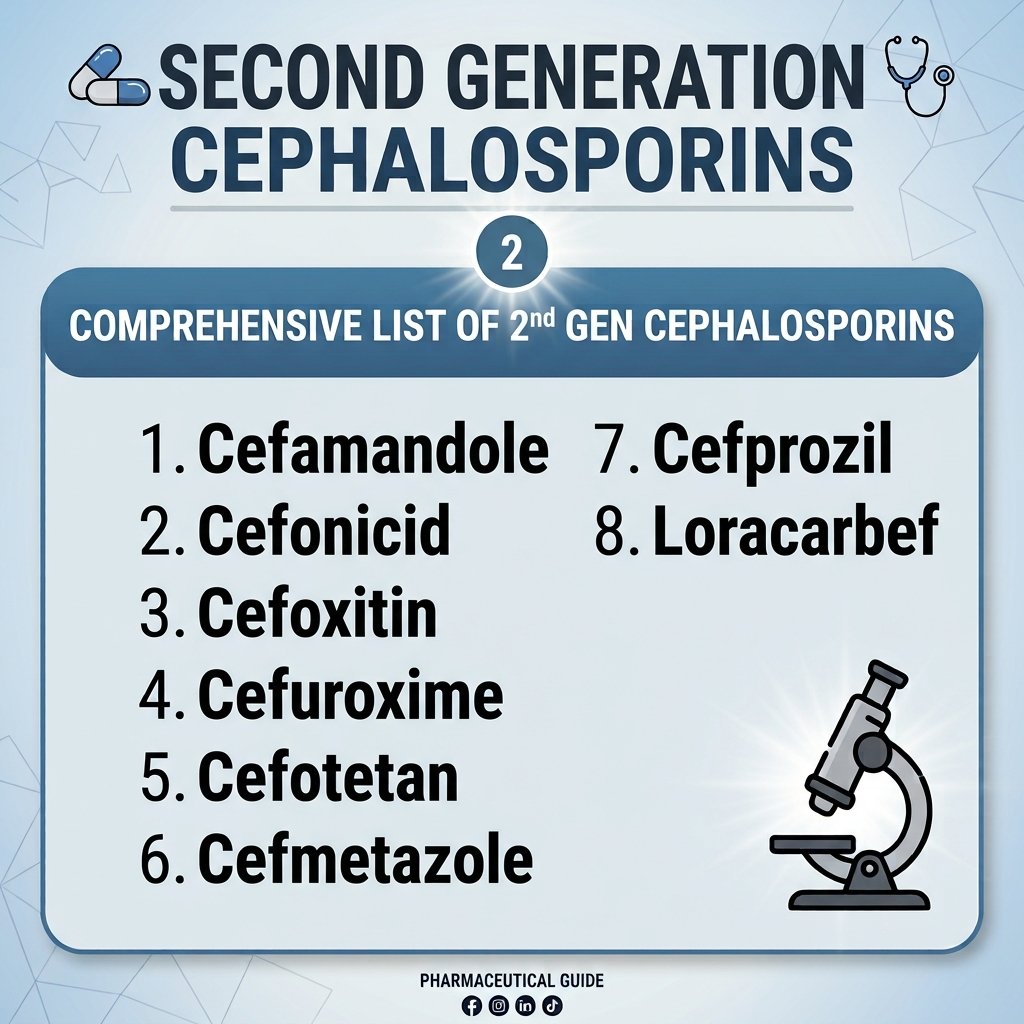
List of Second-Generation Cephalosporins
- Cefuroxime (axetil and sodium salt forms)
- Cefaclor
- Cefprozil
- Loracarbef (carbacephem)
- Cefoxitin (cephamycin)
- Cefotetan (cephamycin)
- Cefmetazole (cephamycin)
- Cefonicid (less commonly used today)
- Ceforanide (largely obsolete)
Classification of Second Generation Cephalosporins
True Second-Generation Cephalosporins
- Cefuroxime
- Cefaclor
- Cefprozil
- Loracarbef (a carbacephem, often grouped here)
Cephamycins
- Cefoxitin
- Cefotetan
- Cefmetazole
Classification by route of Administration
Oral:
- Cefuroxime (Axetil)
- Cefaclor
- Cefprozil
- Loracarbef
Parenteral (IV/IM):
- Cefuroxime sodium
- Cefoxitin
- Cefotetan
- Cefmetazole
Mechanism of Action
Like all beta-lactams, second-generation cephalosporins work by:
- They bind to Penicillin-Binding Proteins (PBPs) on the bacterial cell membrane that cross-link peptidoglycan strands in the cell wall.
- Inhibiting transpeptidation: The process of blocking the final cross-linking step of peptidoglycan synthesis, which weakens the cell wall.
- Autolysins/murein hydrolases: The weakened wall, combined with activation of bacterial autolytic enzymes, causes osmotic instability and cell lysis, particularly in actively dividing bacteria.
Because this mechanism targets cell wall synthesis, cephalosporins are bactericidal with a good general safety margin.
Uses of Second Generation Cephalosporins
Gram Positive Coverage
They have high effective results against Streptococcus pneumoniae, Streptococcus pyogenes, and methicillin-susceptible Staphylococcus aureus (MSSA). Gram-Negative Coverage (the key advance over 1st generation)
- Haemophilus influenzae (including many beta-lactamase producers)
- Neisseria gonorrhoeae and Neisseria meningitidis
- Moraxella catarrhalis
- Escherichia coli, Klebsiella pneumoniae, Proteus mirabilis (some strains)
Clinical Uses
- Upper and lower respiratory tract infections: sinusitis, otitis media, community-acquired pneumonia, bronchitis exacerbations (cefuroxime, cefaclor, cefprozil)
- Pharyngitis/tonsillitis (as an alternative to penicillin)
- Urinary tract infections
- Skin and soft tissue infections
- Surgical prophylaxis, especially abdominal, colorectal, gynecologic, and pelvic surgery (cefoxitin, cefotetan)
- Pelvic inflammatory disease (PID) is well treated by cefoxitin or cefotetan combined with doxycycline.
- Intra-abdominal infections (mixed aerobic-anaerobic) are also treated by second generation cephalosporins.
- Gonorrhea is treated by cefuroxime with historically used. While, Nowadays ceftriaxone (3rd gen) is now preferred
- Lyme disease is treated by cefuroxime while axetil is used as an alternative for early Lyme disease.
Side Effects of Second Generation Cephalosporins:
- Gastrointestinal upset like nausea, diarrhea, abdominal discomfort
- Hypersensitivity reactions including rash, urticaria, pruritus
- Injection site reactions (pain, phlebitis) with IV/IM formulations
Risks Factors of Second Generation Cephalosporins:
- Cross-reactivity with penicillin allergy: low (often cited ~1–3%) but caution warranted with severe/anaphylactic penicillin allergy history.
- Anaphylaxis is rare but possible.
- Clostridioides difficile-associated diarrhea/colitis were reported as with most broad-spectrum antibiotics.
- Disulfiram, like reaction with alcohol notably with cefotetan (and, to a lesser extent, cefmetazole) due to a methylthiotetrazole (MTT) side chain. Avoid the use of alcohol during and shortly after treatment.
- Bleeding risk/hypoprothrombinemia, also linked to the MTT side chain in cefotetan. Vitamin K may be needed in at risk patients (renal impairment, poor nutrition, prolonged therapy). “Transamin injection” is also used for stopping minor bleeding (excluding direct Venous Bleeding)
- Nephrotoxicity has been reported at low risk alone, but caution when combined with other nephrotoxic drugs (e.g. aminoglycosides).
Precautions
- Dose adjustment is necessary and is required in renal impairment.
- Use caution in patients with a history of colitis or GI disease.
- Avoid breastfeeding, generally it is safe but should be used when clearly indicated.
- Avoid alcohol with cefotetan/cefmetazole.
8. Commonly Used Second-Generation Cephalosporins
| Drug Name | Administration Route |
| Cefuroxime (axetil/sodium) | Oral & IV |
| Cefaclor | Oral |
| Cefprozil | Oral |
| Loracarbef | Oral |
| Cefoxitin | IV/IM |
| Cefotetan | IV/IM |
| Cefmetazole | IV/IM |
11. Frequently Asked Questions
Q1. What makes a cephalosporin “second generation”?
Second-generation cephalosporins are specialized in acting against gram-negative bacteria (especially H. influenzae, Neisseria, and Moraxella catarrhalis) as compared to first-generation drugs, while retaining moderate gram-positive coverage.
Q2. What is the difference between second generation cephalosporins and cephamycins?
Cephamycins (cefoxitin, cefotetan, cefmetazole) are chemically related but have an added 7-alpha-methoxy group that gives extra stability against beta-lactamases and have very useful activity against anaerobic bacteria like Bacteroides fragilis, something the “true” second-generation agents (cefuroxime, cefaclor) lack.
Q3. Can someone allergic to penicillin take a second-generation cephalosporin?
The risk of cross-reactivity is generally low (roughly 1–3% in studies), but patients with a history of severe/anaphylactic penicillin allergy should be evaluated carefully and often avoid cephalosporins unless allergy testing or specialist guidance supports use.
Q4. Is cefuroxime effective against sinusitis and ear infections?
Yes, Cefuroxime (and cefaclor, cefprozil) are commonly used for acute otitis media, sinusitis, and other respiratory tract infections due to activity against H. influenzae, Streptococcus pneumoniae, and Moraxella catarrhalis.
Q5. Why should alcohol be avoided with cefotetan?
Cefotetan (and cefmetazole) contain a methylthiotetrazole (MTT) side chain that can cause a disulfiram-like reaction with alcohol e.g. flushing, headache, nausea, vomiting, and palpitations, so alcohol should be avoided during treatment and for about 48–72 hours afterward.
Q6. Do second-generation cephalosporins cover MRSA or Pseudomonas?
No. Second-generation cephalosporins do not have reliable activity against MRSA, Pseudomonas aeruginosa, Enterococcus, or Listeria monocytogenes.
Q7. What is cefoxitin mainly used for?
Cefoxitin is primarily used for surgical prophylaxis (especially abdominal/colorectal/gynecologic surgery), intra-abdominal infections, and pelvic inflammatory disease, owing to its useful anaerobic coverage.
Q8. Are second-generation cephalosporins safe in pregnancy?
They are generally considered to have a favorable safety profile in pregnancy and are commonly used when clinically indicated, but the decision should always be made with a healthcare provider.
Q9. How are second-generation cephalosporins different from third-generation ones?
Third-generation cephalosporins (e.g., ceftriaxone, cefotaxime, ceftazidime) generally have even broader gram-negative activity, better CNS penetration (useful for meningitis), and in some cases (ceftazidime) anti-pseudomonal activity, often at the cost of reduced gram-positive coverage compared to first/second generation drugs.
Q10. Can second-generation cephalosporins treat gonorrhea?
Cefuroxime has historically been used for uncomplicated gonorrhea, but current guidelines favor third-generation agents like ceftriaxone due to superior efficacy and resistance patterns.
Q11. What to use instead of Ancef?
Vancomycin (used for surgical prophylaxis), Clindamycin, Gentamicin or Aminoglycosides, Metronidazole (Flagyl), Cefuroxime or Ceftriaxone are the common alternatives of Ancef.